
![]() |
![]() |
![]() |
|||||||||||||
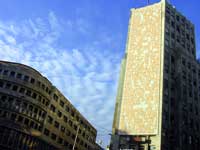
| Unveiling of the Portrait: I am Dragan Stankic, I live at Terazije, Belgrade | Unveiling of the Portrait: I am Dragan Stankic, I live at Terazije, Belgrade | Visiters, pasangers, and friends folowing the ewent on Palace "Albania" Terazije | |||||||||||||
![]() |
![]() |
![]() |
|||||||||||||
| Two alpinist fixing the Portrait, PVC banner, to the facade of Palace "Albania" | The portrait of Dragan Stankic at the facade of "Albania" palace. The Homeless Belgrade 2003. | The Portrait of Dragan Stankic, homeless who lives at Terazije Square in Belgrade | |||||||||||||
![]() |
![]() |
||||||||||||||
| The portrait of Dragan Stankic at the facade of "Albania" palace. The Homeless Belgrade 2003. | Visiters, pasangers, and friends folowing the ewent on Palace "Albania" Terazije | ||||||||||||||
|
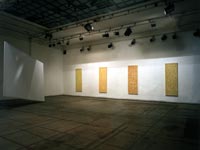
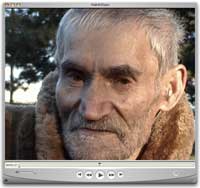
Homeless Belgrade consists of a set of transfigurative portraits of homeless men in Belgrade. Besides a presentation in public space at the Palace "Albania", Terazije Square. 8 Portraits will be on display at Centre for Cultural decontamination - Paviljon Veljkovic, pigment on linen, 250x86cm. The centre will also host a documentation room in which video interviews with the portrayed,
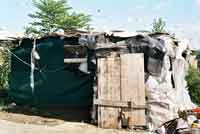
"My Name is Dragan Stankic. I live at Terazije Square, Belgrade." They live invisible under Bridges and in railway stations, built their Houses on clearways and Backyards - the homeless men of the cities. The artist Milovan Destil Markovic has visited interviewed and painted them - in Belgrade, Tokyo and Berlin. Thus Markovic has created a set of impressive portraits that not only tell us about the individual path of life of the portrayed, but also about the social conditions of the society which they inhabit.. The fusion of both elements in one intense transfigurative portrait is the aim and art of Markovic. Be it in the ruins of Belgrade, under the bridges of Tokyo or on the backyards of Berlin - the locations and individual stories might differ - their presence in the social constitution of modern cities is the same nonetheless: they are invisible. Homeless don't play a role in the economics of society and therefore they are not represented. We don't face the images of the losers, though we are confronted with the multiple faces of the successful; smiling ubiquitously from billboards and banners, thus carrying the flag of the capitalist society. Yet 'the flag of permanent defeat', as Hemmingway put it, remains in ragged shadows. Markovic now turns the tables with these politics of representation. His transfigurative portraits elevate men without social standing to icons, thus challenging the prototypes of our success-based society. A single passage of the homeless' self told life story is selected for the painting. It includes information about the portrayer's personality, the conditions of his failure and the influences of the surrounding culture and society. Therefore the transfigurative portraits of Markovic not only reveal the person, but also refer to the society - which has always been a key-quality of portrait painting. Affixed with pigment on linen, the sole text passage becomes a transfigurative portrait of the invisible people of modern cities. Presented on a huge (advertising) banner in the heart of the city at Terazije Square, the portrait tells us the story of a different life. By using the form of an advertising banner in public space, the portrait precisely questions the ruling mechanisms of representation in our society. The Homeless Belgrade project is realised and exhibited by Centre for Cultural decontamination, Paviljon Veljkovic, Belgrade Karminke - Girls from Belgrade, from the series of Lipstick Portraits exhibited in Gallery Zvono, Belgrade |
|||||||||||||||
